
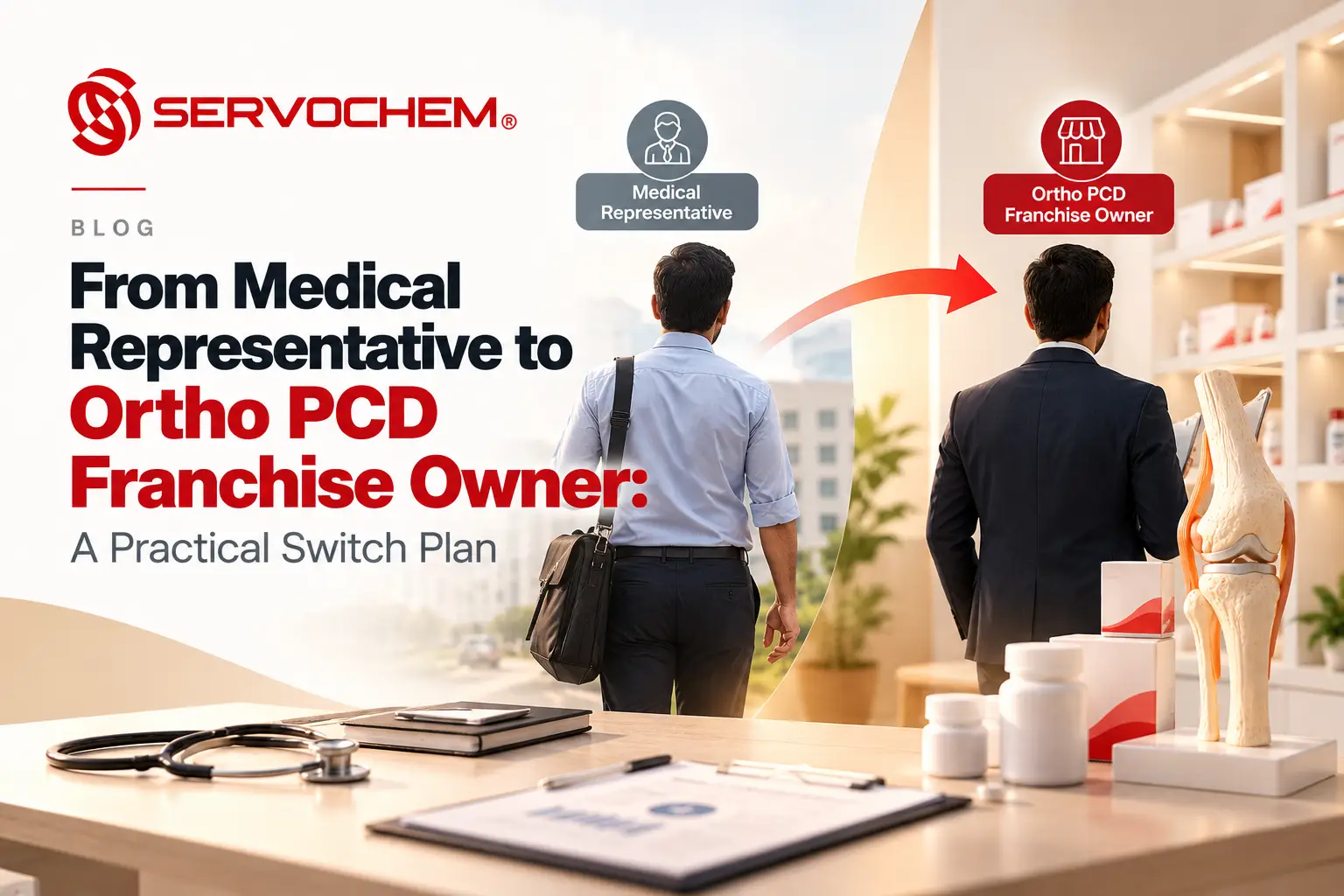
If you work as a medical representative, you already know the hardest parts of pharma sales: reaching doctors, handling objections and hitting targets. Starting your own ortho PCD franchise lets you use the same skills to build a business with your name on the orders. The switch needs planning, because your salary stops and your costs begin. This guide lays out a practical plan: what your experience gives you, what you still need, how to prepare before you resign, and how to run your first ninety days.
A medical representative arrives with skills that most first-time entrepreneurs lack. Look at what you already have:
These strengths matter more than capital in the early months. A partner with strong doctor relationships and a small first order often outperforms a partner with a large budget and no contacts.
The work looks similar, but the risk changes. As a representative, the company pays your salary and bears the stock risk. As a franchise owner, you carry both.
Expect these shifts:
Plan your finances with this in mind. A common guideline is to hold at least three to six months of personal expenses in reserve before you leave your job.
Orthopedic and pain-management products are a natural fit for a new orthopedic PCD pharma franchise owner. Joint pain, back pain, bone health and nerve pain affect patients of every age, and treatment often runs for weeks or months. That creates repeat prescriptions.
The doctor base is also wide. Orthopedic surgeons lead, but general physicians, physiotherapists, gynaecologists and consulting doctors in smaller towns also prescribe ortho products. If you already visit these groups, you can start promoting without building a new network.
Do the groundwork while you still earn a salary. This phase usually takes one to three months.
The Servochem guide to documents required to start an ortho PCD franchise lists what to prepare.
Your supplier decides your quality, supply and margin, so choose with care. Use this checklist when you compare companies:
Servochem is an ortho PCD franchise company in India with GMP compliant manufacturing, a wide orthopedic range and written area terms. You can compare any offer against this list before you decide.
New owners often over-order because they fear running out. A better approach is to start small and learn from real prescriptions.
This approach protects your cash and shows you quickly which products your doctors prefer.
A simple plan keeps you focused.
Days 1 to 30: Introduce. Visit your shortlisted doctors, present your range and leave samples. Visit chemists, check their stock and explain your products. Aim for consistency over volume.
Days 31 to 60: Follow up. Return to doctors who showed interest. Ask about patient feedback. Take small orders from chemists and make sure products reach the shelf on time.
Days 61 to 90: Review and adjust. Check which products move and which do not. Reorder winners, reduce slow items and expand to new doctors. Track your sales, costs and profit in a simple sheet.
Most partners find that the second and third months bring the first steady prescriptions, since doctors need time to try a product before they commit.
Rules protect your licence and your reputation, so follow them from day one.
You can read more about drug regulation at the Central Drugs Standard Control Organisation, India’s national drug regulator. For a view of what comes after the paperwork, read what happens after signing a PCD franchise agreement.
The move suits representatives who want to build something of their own, have strong doctor relationships and can manage a few months of uncertain income. It suits less well if you depend on a fixed salary for family expenses with no reserve.
If you are unsure, start by speaking with franchise companies, comparing terms and building a simple budget. The answers will become clearer once you see real numbers.
Servochem supports new partners with a focused orthopedic range, GMP compliant manufacturing, samples and clear area terms. If you are ready to move from salary to business, start with the Servochem homepage, review the product range and contact the team to request the current product list, minimum order terms and area availability for your city.
Check your employment contract first. Many contracts restrict outside business activity or competing work. Prepare your licence and shortlist suppliers during your notice period, and start selling only when your contract allows it.
The amount depends on the first order, licence costs, promotional material and working capital. Ask each company for its minimum order in writing, then add at least three months of personal and field expenses.
Many partners see their first steady prescriptions within two to three months of regular doctor visits. Earnings grow as repeat prescriptions build, so plan your finances for a slow start.
Yes. You need a valid drug licence and GST registration to buy and sell medicines. Apply early, since approval time varies by state.
Start with four to six products across pain relief, joint support, bone health and nerve health. Add more once you see what your doctors prescribe.
You can meet any doctor, but check your employment contract for restrictions on soliciting contacts or customers. Build your list from relationships you formed in a way that your contract allows.
 Ortho PCD Franchise Investment in India: Costs, Margins and Break-Even Explained
 Ortho PCD Pharma: What a Medicine Manufacturing Company in India Does for Your Franchise
 PCD Company in Gujarat: Pharma Franchise Opportunities Across the State
 PCD Pharma Franchise in Madhya Pradesh: What Ortho Partners Need to Know
 What to Actually Check Before Choosing a Medicine Manufacturing Company