
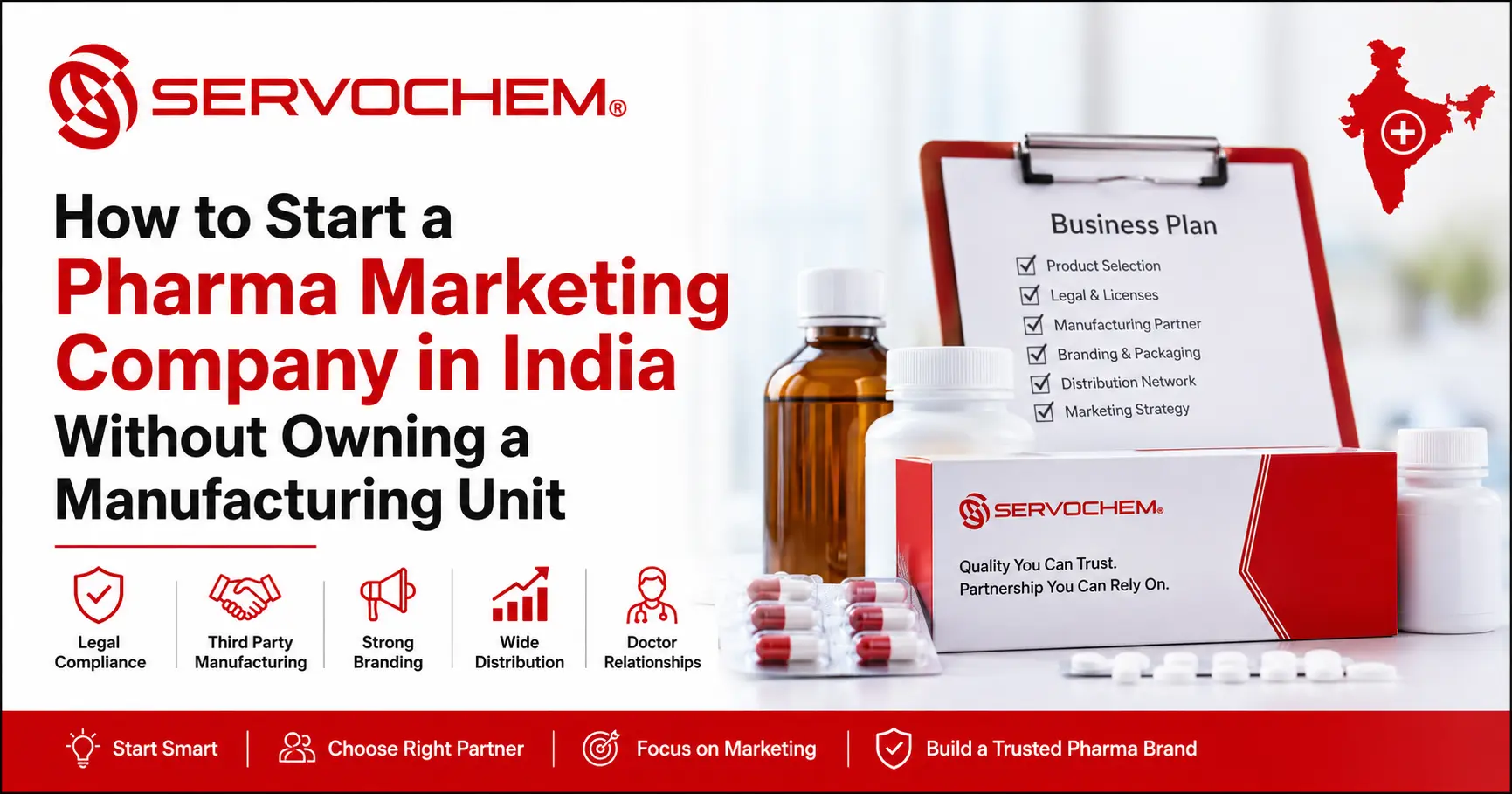
Starting a pharmaceutical business no longer requires investing crores in your own manufacturing facility. Today, many successful pharma brands in India operate as marketing companies, building their own product identity while outsourcing production to licensed third-party manufacturers. They focus their energy on branding, doctor relationships, and distribution. At the same time, the manufacturing side is handled by a partner who already has the required manufacturing licences, infrastructure, and quality systems in place.
If you are exploring how to start a pharma marketing company in India, the good news is that the model is simpler than most people assume, as long as you understand the process and follow the regulatory steps in the right order.
A pharma marketing company owns the brand. It decides the product name, packaging, pricing, and target market, then hands over the actual production to a manufacturing partner that already holds the required licenses and infrastructure. The manufacturer sources raw materials, runs the batch, tests it against pharmacopoeial standards, and packs it according to your approved artwork. Your job is to get that finished product into the hands of doctors, chemists, and distributors.
This is often confused with a PCD pharma franchise model, and the two do overlap. The difference is mainly in scale and control. A marketing company usually builds its own brand identity from the ground up. It may eventually appoint franchise partners of its own, while a PCD franchise typically works under an already established brand and product basket.
At a glance, working with a third party pharma manufacturing company usually follows a simple sequence: you finalize the product and pack size, obtain a commercial quotation, approve the packaging artwork, the manufacturer produces and quality-tests the batch, and the finished stock is dispatched to your warehouse. The steps below cover each of these stages in more detail, along with the legal and business groundwork you need before production even begins.
Your first decision should be selecting a therapeutic segment that aligns with the healthcare market you plan to serve. Orthopedics, gynecology, pediatrics, and general physician ranges are common starting points because prescription volumes are steady across most regions of India. In many cases, companies pick a molecule simply because it is popular at the national level, but prescription patterns often vary district to district within the same state. Talk to a few practicing doctors or field representatives in the specific territory you plan to launch in first, since local feedback usually matters more than a national bestseller list.
A mistake many new companies make is ordering too many SKUs in the first batch to look established from day one. Many new companies begin with a focused portfolio of fast-moving products, establish doctor coverage, and gradually expand their product range as demand grows.
Your brand name is what a doctor will remember and write on a prescription pad, so it needs to be short, easy to pronounce, and distinct from existing brands in the same category. Before you commit to a name, search the trademark database yourself to confirm it is not already taken. Skipping this step is one of the most common and expensive mistakes new companies make, since a rebrand after your first stock is printed costs far more than a trademark search would have. Filing the trademark early, rather than after your product is already in the market, also avoids the awkward situation of a competitor registering it first.
Pharma is a regulated industry, so paperwork comes before promotion. At a minimum, you will need to register a business entity, typically a proprietorship, partnership, or private limited company depending on how you plan to scale. You will also need GST registration for billing and interstate supply.
The most important document is your wholesale drug license, issued by the state drug control authority. Requirements around staffing, such as a registered pharmacist, and the premises needed for this license can vary from state to state, and drug control rules are updated from time to time. It is worth confirming the current requirements with your respective State Drug Control Authority before you apply, rather than relying on what applied a year or two ago.
Trademark registration for your brand name is not legally compulsory to start selling. Still, it protects you from a competitor copying your name later, and most established marketing companies treat it as a non-negotiable step.
This is the decision that determines the quality of everything you sell, and it deserves more diligence than most first-time founders give it. Many new companies compare manufacturers mainly on quoted rate per box. In practice, a difference of a few rupees per unit matters far less than delayed dispatches, inconsistent batch-to-batch quality, or a manufacturer who cannot produce a certificate of analysis when a distributor asks for one.
Look beyond the quotation and ask about their GMP certifications (such as WHO-GMP, where applicable), their quality control processes, and whether they conduct stability studies for their formulations. A manufacturer that can show you sample batch documentation and speak comfortably about their quality systems is usually a safer long-term partner than one who only talks price.
Ask direct questions during your first conversation. What is their minimum order quantity per batch? What is their typical turnaround time from artwork approval to dispatch? Do they support you with product literature and visual aids, or is that entirely on you? If your initial range includes tablets, capsules, or sachets, confirm they have direct manufacturing experience in those specific dosage forms rather than a general claim of capability.
Once you agree on terms, everything is formalized through a contract manufacturing agreement that spells out pricing, quantities, quality responsibilities, and delivery timelines. This is also where it helps to work with a manufacturing partner whose core business is contract pharmaceutical manufacturing, since their processes and documentation are built specifically around supporting third party brands rather than treating it as a side activity. It is also worth keeping a secondary supplier in mind for critical products, so a single manufacturing delay does not stall your entire product line.
Packaging is not just design. Every strip, bottle, or sachet must carry accurate composition details, batch number, manufacturing and expiry dates, and license information as required under Indian drug labeling rules. Get your packaging artwork reviewed against these requirements before printing, because a labeling error caught after printing can hold up your entire stock at the manufacturer's end and push your launch back by weeks.
Once your first batch is manufactured and dispatched to your warehouse, your focus shifts entirely to sales. Most marketing companies start by appointing stockists in a few key districts, then expand as demand grows. Field visits, sample distribution to doctors, and consistent supply to your stockists matter more in the early months than any marketing spend, since trust in this industry is built prescription by prescription, not through a single big launch.
No fixed figure applies to every company, since it depends on how many products you launch and how much stock you order in your first batch. Broadly, your funds will go toward three areas: business registration and licensing, your first production order, and promotional material such as visual aids and product samples for doctors. Many entrepreneurs start lean with a limited product range and reinvest early revenue to expand their basket, rather than stretching thin across a wide range from day one.
A few patterns show up repeatedly among new entrants in this business.
None of these mistakes are difficult to avoid once you know to look out for them, but they are rarely mentioned in generic guides on the topic.
Yes. This is exactly what third party pharmaceutical manufacturing allows. You handle the brand and sales, while a licensed manufacturer handles production.
A marketing company typically builds and owns its own brand from scratch and may later appoint franchise partners. A PCD franchise usually operates under an already established company's brand and product range, with lower upfront branding effort.
A business registration, GST registration, and a wholesale drug license are the essentials. A trademark for your brand name is strongly recommended but not legally mandatory. Exact documentation and premises requirements for the drug license can vary by state, so confirm current norms with your local Drug Control Authority.
It is not mandatory under Indian law for a marketing company to only work with WHO-GMP certified manufacturers, but WHO-GMP certification is commonly regarded as a positive indicator of quality management practices and may be preferred by many distributors and institutional buyers.
Yes, once your wholesale drug license and GST registration are in place, you can supply to distributors and stockists across states, subject to standard interstate trade documentation.
You need storage premises that comply with the requirements of your State Drug Control Authority for obtaining a wholesale drug license. Where permitted, many small businesses begin with a modest office-cum-storage setup and expand their storage capacity as operations grow.
It varies by manufacturer and product complexity, but expect the process to cover artwork approval, production, and quality testing before dispatch, so plan your launch timeline with some buffer rather than a fixed date.
Starting a pharma marketing company in India is a realistic path for entrepreneurs who understand that success here depends less on capital and more on discipline: choosing the right product segment, completing your licensing correctly, and partnering with a manufacturer you can actually rely on when something does not go as planned.
The right manufacturing partner should do more than run your batches. They should support you with documentation, packaging compliance, production planning, and consistent quality as your product range grows, so that your brand's reputation in the market rests on something solid. If you are evaluating manufacturing partners, compare their documentation support, production capability, and quality systems, not just their pricing.
Servochem works with pharma marketing companies and franchise partners across India, offering GMP-compliant contract manufacturing for tablets, capsules, and sachets, along with the documentation support new brands need when they are getting started.
 From Medical Representative to Ortho PCD Franchise Owner: A Practical Switch Plan
 Ortho PCD Franchise Investment in India: Costs, Margins and Break-Even Explained
 Ortho PCD Pharma: What a Medicine Manufacturing Company in India Does for Your Franchise
 PCD Company in Gujarat: Pharma Franchise Opportunities Across the State
 PCD Pharma Franchise in Madhya Pradesh: What Ortho Partners Need to Know